Roof Repair
Wind-lifted ridge caps and creased tabs on exposed slopes put back down and sealed, with the leak traced to its real source before anything is quoted.
Roof repair →
Buford pairs an old railroad downtown with large new subdivisions on freshly cleared ground, and those open lots take North Georgia wind and hail with very little shelter around them.
Good roofing in Buford starts with knowing which Buford the house belongs to. The city straddles the Gwinnett and Hall County line, with a historic downtown at its center, the Mall of Georgia to the south and Lake Lanier to the north, and a great deal of new housing filling the ground in between.
The older streets around downtown hold houses that have been reroofed more than once over the decades. The newer subdivisions are a different proposition: large neighborhoods built in quick succession, where whole streets of roofs went on within a few seasons and will age on roughly the same clock.
Being in two counties matters less to a roof than people expect. Hail and wind do not stop at the county line, and the questions we ask on the roof are the same either side of it: how old is it, what is it made of, and what has the weather already done to it.
Most of the north metro we work in sits under mature hardwood canopy. Much of new Buford does not. Land cleared for a subdivision leaves roofs standing in the open with saplings for company, and that changes how they wear.
A roof with nothing around it takes the full force of a summer thunderstorm. Straight-line wind gets under shingle edges along the ridge and the rakes, and hail strikes every slope rather than the ones a tree canopy leaves exposed. The same open ground also means full sun and Georgia heat on every slope all day, which is hard on shingles and on the attic below them.
That makes attic ventilation worth checking on even a young Buford roof. Shingles cook from above in the sun and from below when the attic cannot breathe, and on an exposed lot both happen at once.
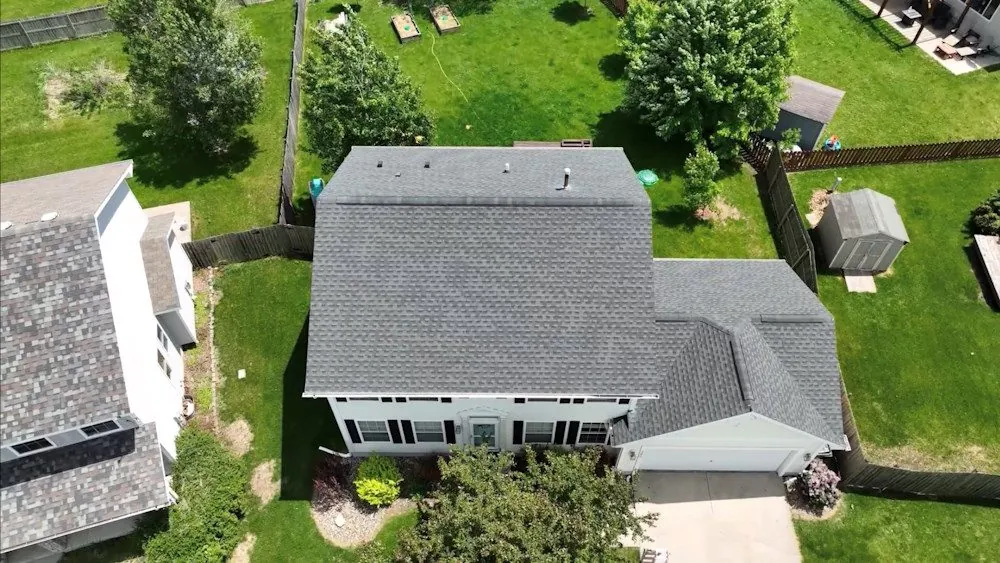
Seen from above, a well-installed replacement is uniform: straight courses, a clean ridge line, valleys cut tight, and every pipe boot new. That consistency is what lets a roof shed water and resist wind uplift evenly across every slope, which matters most on a house with no trees to break the weather.
We tear the old roof off completely, replace any soft decking, and rebuild with underlayment, drip edge and ice and water shield at the valleys and transitions. Around 95% of our replacements are finished in a single day, and every one carries our lifetime workmanship warranty.
Wind-lifted ridge caps and creased tabs on exposed slopes put back down and sealed, with the leak traced to its real source before anything is quoted.
Roof repair →The old downtown roofs and the first subdivision roofs alike stripped to the deck, with soft boards replaced and ventilation corrected before the new shingle goes on.
Roof replacement →Every slope photographed after a hail or wind event, a written report for your insurer, and one of us beside you when the adjuster comes to look.
Storm damage →We cover Buford on both sides of the county line: the streets around the historic downtown, the neighborhoods off I-985 toward Lake Lanier, the subdivisions around the Mall of Georgia, and the newer building spreading out between them.
Buford is a short run up from our Alpharetta base, where we have been since 2010, so a response is usually the same day or the next. Active leaks and storm damage take priority over everything else on the schedule.
Some Buford homeowners ask about metal instead of shingle, particularly on houses that sit exposed on open lots. It is a real option and one we install, but whether it suits a particular house depends on the roof's pitch, its shape and how long you plan to stay. Our metal roofing page sets out where it earns its keep and where architectural shingle is the better value.
A temporary repair is for one thing: keeping water out until a proper repair or replacement can be done. After a storm, cover the damage if it is safe to, photograph it before anything is moved, and call us. A tarp buys time; it is not the fix, and we will say so plainly.
Buford's neighbors age their roofs differently. Our page on roofing in Suwanee covers the planned neighborhoods just down the interstate, where the trees are older and the questions run more toward HOA rules and resale.
There is no honest figure without seeing the roof. Price follows the roof area, the pitch, how many valleys and penetrations it has, how many layers are coming off and how much decking is soft underneath. The free inspection gives you that in a written report before any number is quoted.
Not by itself. Compare quotes line by line: full tear-off or a layer over, how much decking replacement is allowed for, which underlayment, whether ice and water shield goes in the valleys, and what warranty covers the workmanship. A higher number with a fuller scope can be the better buy.
Yes. We inspect the roof first, because pitch, shape and the condition of the deck all affect whether metal makes sense, then give you the estimate in writing alongside the architectural shingle option so you can compare.
Contain the water inside, cover the damage only if it is safe to reach, and photograph everything before it is moved. Then call us. Active leaks take priority, and the photographs help if the leak turns out to be a claim.
Yes. The inspection, the photographs and the written report cost nothing and carry no obligation, whether the answer is a repair, a replacement or nothing at all.
Usually the same day or the next. If water is coming in, call rather than emailing so we can move you up the list.
Storm damage isn’t always visible from the ground. We’ll document what we find, walk you through the report, and tell you honestly whether you need a repair, a replacement, or nothing at all.