
Based on This Old House’s Georgia roof replacement cost guide (updated June 16, 2026) and new roof cost guide (updated October 7, 2026).
The average roof replacement cost in Georgia is about $8,918, according to This Old House, with most jobs falling between $6,965 and $21,455. Where your roof lands in that range comes down to five things: how big the roof is, how steep, how complicated, what comes off it, and what goes back on. An asphalt shingle roof on a simple one-story house sits near the bottom. Metal, slate or a cut-up two-story roof with dormers and valleys sits near the top.
This guide walks through the published numbers by size and material, what each part of a quote pays for, and the one cost nobody can price until the old roof is off. If you want a written figure for your own house, our roof replacement page explains how we quote, and the inspection that comes before it is free.
What’s in this guide
- Roof replacement cost by size
- Cost by material: shingles or metal?
- What a replacement quote pays for
- The cost nobody can quote in advance
- Georgia factors that move the price
- The cheapest way to replace a roof, done properly
- Comparing two quotes
- Roof replacement cost questions
Roof Replacement Cost by Size
There are two ways to measure size, and published guides use both, which is why their tables rarely agree. One is the home’s floor area. The other is the roof’s surface area, which is larger than the footprint because of the overhangs and the pitch. Roofers price by the roof, in “squares” of 100 square feet.
This Old House publishes both. Its Georgia figures go by home size; its national asphalt figures go by roof area:
| Size | Georgia, by home size (all materials) | U.S., asphalt shingle by roof area |
|---|---|---|
| 1,000 sq ft | $7,506 (one story) | $5,160 |
| 1,500 sq ft | $9,094 (one story) | $7,740 |
| 2,000 sq ft | $9,272 (two stories) | $10,320 |
| 2,500 sq ft | $10,370 (two stories) | $12,900 |
| 3,000 sq ft | $11,941 (two stories) | $15,480 |
A 2,200-square-foot two-story house falls between the 2,000 and 2,500 rows of the Georgia column. Its roof, though, could easily measure 2,500 square feet or more once you count the overhangs and the slope, which is why a roofer measures the roof rather than reading the square footage off the listing.
Notice that the Georgia figures climb slowly with home size. A two-story house puts the same living space under a smaller roof than a ranch does, so a 2,000-square-foot two-story often has less roof to replace than a 1,500-square-foot ranch.
Cost by Material: Is It Cheaper to Replace a Roof With Shingles or Metal?
Shingles, by a wide margin, at least up front. These are This Old House’s national figures for a 2,000-square-foot roof:
| Material | Total, 2,000 sq ft roof | Per sq ft | Typical lifespan |
|---|---|---|---|
| Asphalt shingles | $10,319 | $5.16 | 30–35 years |
| Wood shake | $26,302 | $13.15 | 30–50 years |
| Metal | $38,593 | $19.30 | 40–70 years |
| Clay tile | $44,423 | $22.21 | 50–100 years |
The Georgia guide puts its averages lower across the board (asphalt $6,965, metal $13,745, slate $21,455), partly because it measures by home size. Either way the order is the same, and asphalt shingle is the cheapest roof to put on.
In our experience an architectural asphalt shingle roof lasts around 25 to 30 years in Georgia, less on shaded slopes and over a poorly ventilated attic. Metal roofing typically lasts two to three times as long, so it pays back only if you plan to stay in the house. Impact-rated shingles sit between the two on price, and some insurers discount premiums for them, so ask yours before you choose.
Slate is the outlier. This Old House puts it at $14.93 a square foot in Georgia, the highest of any material it lists.
What a Replacement Quote Pays For
Labor is about 65% of the total, according to This Old House. The rest is materials, disposal and the extras that a careful quote lists line by line:
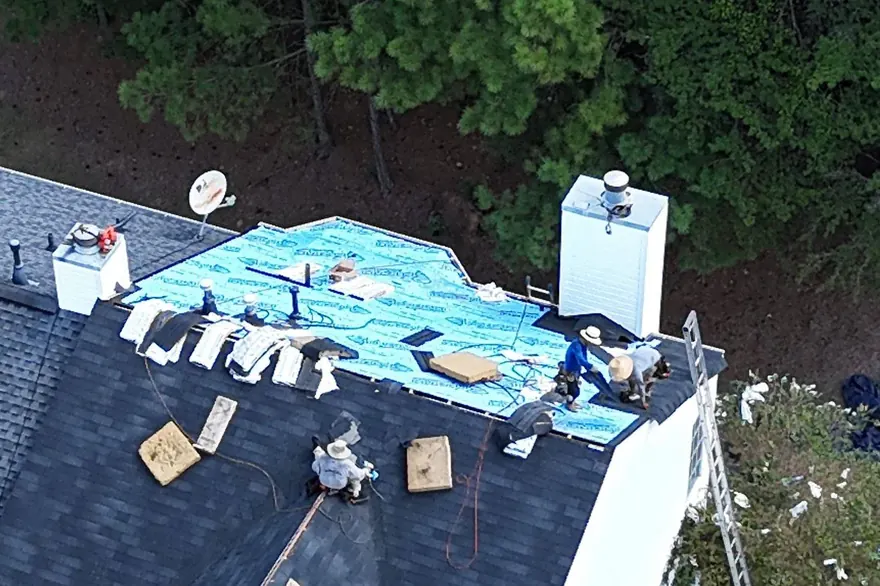
- Tear-off and disposal. Removing the old roof, hauling it away and paying the dump fees.
- Underlayment. The waterproof layer across the whole deck under the shingles.
- Ice and water shield. A self-sealing membrane at valleys, walls and penetrations, where water concentrates.
- Drip edge, flashing and pipe boots. The metal and rubber details that keep water out at every edge and opening. Most leaks start here, not in the shingles.
- Ventilation. Ridge and intake vents so the attic does not cook the new shingles from underneath.
- Permits. This Old House puts Georgia roofing permits at $150 to $500, and says metro areas like Atlanta can have stricter permitting.
- Cleanup. A magnet sweep for nails and a clean driveway at the end of the day.
Steepness and complexity drive the labor figure. A steep roof needs roof jacks, harnesses and a slower pace. Every valley, dormer, skylight and chimney is a detail that has to be flashed by hand, which is why two houses of the same size on the same street can be priced quite differently.
The Cost Nobody Can Quote in Advance
Under the shingles is the decking, the plywood or plank boards the roof is nailed to. If water has been getting in, some of it will be soft or rotten, and it has to be replaced before anything new goes on. Covering bad decking is how a five-year-old roof develops a sag.
Nobody can see the decking until tear-off day, so nobody can honestly price it in advance. This Old House puts dry rot repair in Georgia at $500 to $1,000 and links it to the state’s humidity and storms. The fair way to handle it is to agree a per-sheet rate before the job starts. That is what we do, so finding rot changes the price by a known amount rather than an open one.
Georgia Factors That Move the Price
- Storm season. This Old House says Georgia’s storm season runs roughly March through September and suggests fall through early spring as the time to replace.
- Heat and humidity. Hot, humid summers shorten material life, and an under-ventilated attic shortens it further. Ventilation is worth paying for here.
- Hail. North metro Atlanta gets hail often enough that architectural or impact-rated shingles are the sensible choice over three-tab.
- Trees. Heavy tree cover means shaded slopes, debris in the valleys and, sometimes, limbs to work around, all of which affect the job.
- Insurance. If storm damage is behind the replacement, your policy may pay some or all of it. Age and wear alone are not claimable. Our guide to the insurance roof inspection explains how an insurer decides.
The Cheapest Way to Replace a Roof, Done Properly
An overlay, new shingles nailed over the old layer, is the cheapest way to get a new-looking roof, and This Old House notes that some codes allow two layers. It saves the tear-off but hides the decking, adds weight and usually shortens the new roof’s life. We do full tear-offs, because that is the only way to see what the roof is sitting on.
The legitimate ways to spend less are simpler:
- Choose architectural asphalt shingle. It is the best value for most Georgia homes.
- Replace outside storm season if the roof can wait, when crews are less stretched.
- Find out if you need a replacement at all. A roof with years left and one failed detail needs a roof repair, not a new roof.
- Check whether storm damage is covered before you pay for it yourself.
Comparing Two Quotes
When two quotes are far apart, they are usually for different jobs. Lay them side by side and check that each one includes a full tear-off, new underlayment across the whole deck, ice and water shield at the valleys and penetrations, new drip edge, new pipe boots and flashing, a ventilation check and a decking rate. A low quote that leaves out half the list is not cheaper; it is a smaller job.
Then look at who stands behind it. A workmanship warranty is only worth something if the company is still around when you need it. We have worked from Alpharetta since 2010, we are BBB accredited with an A+ rating, and our replacements carry a lifetime workmanship warranty. Around 95% of the roofs we replace are finished in a single day, cleanup included.
We replace roofs across the north metro, including Alpharetta, Roswell, Johns Creek, Cumming and Marietta. Get a written roof replacement quote after a free inspection, or call (770) 676-1385.
Sources checked November 6, 2026: This Old House, Roof Replacement Cost in Georgia (updated June 16, 2026); This Old House, New Roof Cost (updated October 7, 2026). Published figures are averages; your roof’s price depends on its measurements and condition.
Roof Replacement Cost Questions
How much does it cost to replace a roof in Georgia?
This Old House puts the Georgia average at about $8,918, with most roof replacements between $6,965 and $21,455. Asphalt shingle sits at the low end and slate at the high end. Your price depends on the roof's size, pitch, complexity and material.
How much does it cost to replace a 1,000 square foot roof?
This Old House's national figure for 1,000 square feet of asphalt shingle roof is about $5,160. Its Georgia figure for a 1,000-square-foot one-story home is about $7,506 across all materials. Metal or tile on the same roof costs several times more.
How much does it cost to replace a roof on a 2,200 square foot house?
A 2,200-square-foot two-story house falls between This Old House's Georgia figures of $9,272 for 2,000 square feet and $10,370 for 2,500. The roof itself is measured separately and is usually larger than the floor area because of overhangs and pitch.
Is it cheaper to replace a roof with shingles or metal?
Shingles. This Old House puts asphalt at about $5.16 per square foot of roof against $19.30 for metal. Metal lasts much longer, so it pays back mainly if you stay in the house for decades.
What is the cheapest way to replace a roof?
Architectural asphalt shingle with a full tear-off, scheduled outside storm season if the roof can wait. A layover of new shingles on old ones costs less up front but hides the decking and usually shortens the new roof's life.
Will homeowners insurance pay to replace a roof?
If a storm damaged it, often yes, in part or in full. Age and wear alone are not covered. An inspection that documents the damage and the storm date is the first step, and your insurer makes the decision.