Roof Repair
Leaks around old chimneys, vent pipes and add-on rooms chased to the source, with a plain answer on whether a repair is worth doing.
Roof repair →
Norcross grew up around a railroad depot long before the subdivisions arrived, so a short drive here can take you from a house with a century of roof history to one on its second shingle roof.
Good roofing in Norcross starts with knowing which part of town a house belongs to. The historic downtown sits along the railroad, with older homes on the streets around it, and the rings of 1970s, 1980s and 1990s subdivisions came later as I-85 and Peachtree Industrial Boulevard opened the area up to commuters.
Those two halves of the city ask different questions of a roofer. An older house near downtown has usually been re-roofed several times, and the work under the current shingles is often the bigger unknown. A subdivision house from the seventies or eighties has typically had one replacement already and is now coming up on its second.
We are based in Alpharetta and have worked across the north metro since 2010. Norcross is a straightforward drive down Peachtree Industrial from our base, so a free inspection is usually possible the same day or the next.
A roof replaced in the late nineties or early 2000s on a 1970s house is now old enough to be making its own decisions. Shingles from that period were frequently three-tab, and three-tab is the product that suffers most when North Georgia hail comes through.
The framing under those roofs is older than the shingles. Decking that has been nailed through twice, softened by an old leak or patched by a previous contractor is common on houses of that age, and it is the reason we replace every soft section of deck before anything new goes on rather than shingling over it.
Summer heat and humidity add to the load. An attic that was vented for the standards of the 1970s often runs hot under a Georgia roof, and that heat ages shingles from underneath. Checking ventilation is part of every replacement we quote.
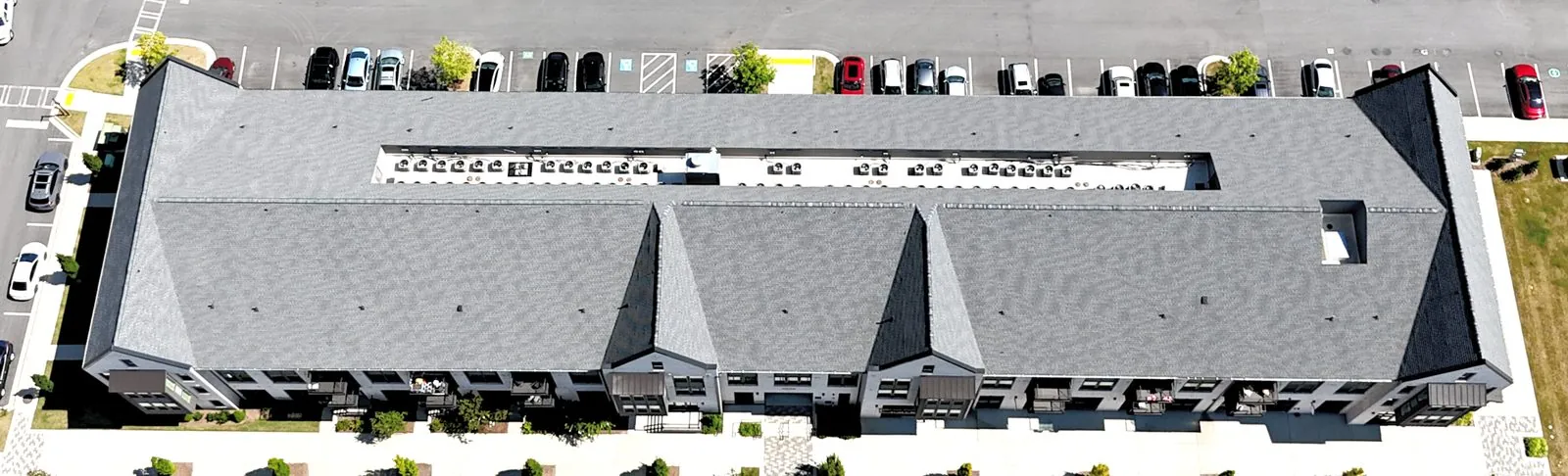
Every replacement is a full tear-off down to the deck. Once soft boards are replaced we lay underlayment, fit drip edge at the perimeter, run ice and water shield at the valleys and wall transitions, and install new pipe boots and flashing.
For a hail-exposed part of Gwinnett we recommend architectural shingle over three-tab, and around 95% of our replacements are finished in a single day. Each one carries our lifetime workmanship warranty.
Leaks around old chimneys, vent pipes and add-on rooms chased to the source, with a plain answer on whether a repair is worth doing.
Roof repair →Tear-off to bare deck, soft boards swapped out, then a new roof with ventilation corrected for an older attic.
Roof replacement →Photographed inspection after hail or high wind, a written report you can send your insurer, and us at the adjuster meeting.
Storm damage →We cover Norcross throughout: the older streets around the historic downtown and the railroad, the subdivisions off Peachtree Industrial Boulevard, and the neighborhoods on either side of I-85 heading toward Duluth.
Norcross borders Peachtree Corners to the north and west, and we cover both. Active leaks and storm damage are always put at the front of the queue.
Not every leak on an older roof means a new roof. A cracked pipe boot, a lifted run of shingles after a windstorm or flashing that has pulled away from a chimney can usually be fixed properly for far less, and a roof with years of life left deserves that. Our roof leak repair work starts with finding where the water actually gets in, which is often a few feet from the stain on the ceiling.
The calculation changes when the shingles themselves are worn out. Brittle tabs, bare granules and repeated leaks in different places mean you are paying to patch a roof that will need replacing anyway, and we will tell you so plainly rather than sell you a repair that buys a single season.
If you live just over the line, the same approach applies to roofing in Peachtree Corners, where the river-side neighborhoods were built over a similar span of years.
It depends on the size and pitch of the roof, how many valleys, chimneys and walls it meets, how much decking needs replacing and the shingle you choose. Older houses vary more than subdivision homes because of what may be under the current roof. A free inspection with photographs and a written report gives you a real figure rather than a guess.
Most houses here have gable or hip roofs, often combined on the same house, covered in asphalt shingle. Some older homes and additions have low-slope sections over porches or rear rooms that need a membrane rather than shingle, and we also install metal roofing for owners who want a longer-lasting option.
Yes. We handle low-slope and flat commercial roofs as well as residential work, and commercial jobs are scheduled around the business that operates underneath.
Move belongings away from the drip, catch the water and keep people away from any ceiling that is sagging or near a light fitting. Take photographs, then call us rather than emailing so an active leak goes to the front of the queue.
Yes. A Haag-certified inspector checks the roof, photographs what matters and gives you a written report, with no charge and no obligation to book anything.
Usually the same day or the next. If water is coming in or a storm has just passed through, say so when you call and we will prioritize it.
Storm damage isn’t always visible from the ground. We’ll document what we find, walk you through the report, and tell you honestly whether you need a repair, a replacement, or nothing at all.